After watching Snow White and the Seven Dwarfs, I decided that it would be fun to go through all the Disney feature films in order. There's actually a bunch that I either haven't seen in a long time, or haven't seen period. Anyway, the film that came out after Snow White was Pinocchio, which also happens to be on the Top 1000 list. Two birds, one stone.
So I was kind of bored today, and I thought, "Hey, why not watch the seminal classic The Toxic Avenger for the first time ever?" And then I checked and saw that it was on Netflix, which is all a movie really has to do for me to watch it.
The next movie I'm watching is the animated classic Snow White and the Seven Dwarfs. This is the movie that made people take Walt Disney (and really the entire idea of an animated feature) seriously. Before this, you've got mostly animated shorts, and pretty much everybody thought a full length animated film would be doomed to failure. This is why you shouldn't listen to pretty much everybody.
The next film on our list is Flaming Creatures, a 1963 short by Jack Smith. Its claim to fame is that it was pulled from very limited distribution after being judged obscene by the New York Criminal Court. Why is it on the list? Mostly because it's edgy and controversial, although surprisingly not that explicit. I mean...considering the fact that the NYPD seized it at the premiere.
The next film on our list is The Purple Rose of Cairo. It's one of the many Woody Allen films included in the Top 1000, and stars Mia Farrow and Jeff Daniels.
The next film on our list is Une Femme Est Une Femme, or A Woman is a Woman. This is a French New Wave film from 1961, directed by Jean-Luc Godard, which means that it is clever, smug, and artsy.
This next film is called Heaven Can Wait. It's an Ernst Lubitsch film from 1943, starring Don Ameche as a deceased playboy.
Imitation of Life was a book about two women bonding, the complicated mother-daughter relationship, and the even more complex issues of race. It was adapted into two films, the first of which came out in 1934, starring Claudette Colbert and Louise Beavers, and the second of which came out in 1959, starring Lana Turner and Juanita Moore. They're both very good films in their own right, but which is better?
The next film on the list is Fritz Lang's The Woman in the Window from 1944. It stars Edward G Robinson, Joan Bennett, and Dan Duryea, a team that would be brought back together for 1945's Scarlet Street, with similar success.
The next film on our list is Rose Hobart, a 19-minute long experimental film that splices together clips from the film East of Borneo featuring Rose Hobart, with footage of a solar eclipse.
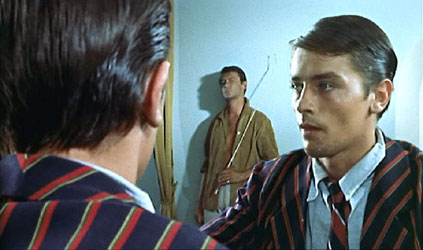
The next film on our list is Plein Soleil, or Purple Noon if you're so inclined. It's a 1960 psychodrama/thriller from France, starring Alain Delon. Tom Ripley has been hired by an American industrialist to bring his shiftless layabout son home to San Francisco, to the tune of $5000.
Our next movies is a 1928 silent film called The Docks of New York, about a stoker who decides to marry a suicidal hooker on his one day of shore leave. This should end well.
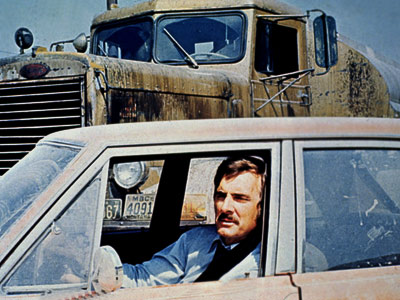
This next film is called Duel, and it has the illustrious honor of being Steven Spielberg's debut film.
The next film we'll be watching is The Gospel According to St Matthew, a 1964 religious drama imported straight from Italy. This is a straightforward adaptation of the Gospel of Matthew, detailing the life and death of Jesus Christ.
The next film on our list is The Heiress, a 1949 drama starring Olivia de Haviland and Montgomery Clift.
The next film on the list is something a little different -- this one's a documentary from 1988 called The Thin Blue Line. Having read the description on Netflix, I have a feeling that this might serve as a companion piece to my 12 Angry Men review.
The next film we'll be watching is 12 Angry Men, a 1957 courtroom drama starring Henry Fonda, in which twelve white men have to determine the guilt or innocence of an urban Hispanic youth. Moral quandaries galore.